
Real Estate Photography Tips for the Agent Shooting It Alone
By Steve · updated October 2026
You already know the listing that got fifty views and the one that got five, and the photos were usually the difference. Everyone assumes the fix is a better camera, and that's rarely where the real problem is. The angle that actually makes a room look bigger comes later in this piece, and it costs nothing.
- The camera is rarely the reason a listing photo underperforms. Light, clutter and angle are.
- One shooting height and one corner angle, repeated in every room, is what makes photos look consistent and spacious.
- The same photos belong on your Google Business Profile.
The gear question everyone asks first
A recent phone shoots a room perfectly well. What it can't fix is bad light, clutter, or a crooked angle, and those three account for almost every listing photo that undersells a house.
A dedicated camera helps in low light and gives you more control over depth of field, but it won't rescue a photo taken at 2pm with the blinds half down. Fix the fundamentals first, upgrade the gear later if you're shooting often enough to justify it.
One setting matters more than the camera body itself: whether your phone's wide-angle or ultra-wide lens mode is on. Ultra-wide (often the 0.5x option) bends straight lines near the edge of the frame, which is why some listing photos make a normal room look like a fisheye lens got hold of it. Stick to the standard 1x lens for interiors.
The first fundamental, and the one that decides the shot before you've pressed anything, is light.
Light decides the shot before you press anything
Turn on every light in the house, including closets and under-cabinet lighting, and open every blind. Shoot in the hour or two after sunrise or before sunset, when the light outside isn't fighting the light inside.
Midday sun through a window next to warm indoor bulbs creates two competing color temperatures in one frame, and your phone's camera will guess wrong about which one to correct for. That's the orange-and-blue mismatch you sometimes see in amateur listing photos.
Swap any obviously burnt-out or mismatched bulbs before the shoot. A room lit by one warm bulb and one daylight bulb photographs worse than a room with fewer lights that all match.
Once the room is lit evenly, the next problem is what's actually in the frame.
The clutter test nobody skips on purpose
Walk every room once before you shoot, specifically looking for what a buyer's eye would catch: cords, pet bowls, personal photos, an open laundry basket. Three or four of those together make a room read as smaller and less cared for, though a single one rarely would.
Close cabinet doors, straighten cushions, put toilet lids down, and clear countertops down to two or three items. A kitchen counter with nothing on it photographs bigger than the same counter mid-use.
Check reflective surfaces last: mirrors, dark TV screens and glass cabinet doors will show you, your tripod or a messy hallway if you're not paying attention to what's behind the camera.
With the room lit and cleared, how you hold the camera decides whether that work pays off.
The single angle that makes a room look bigger, and the one that shrinks it
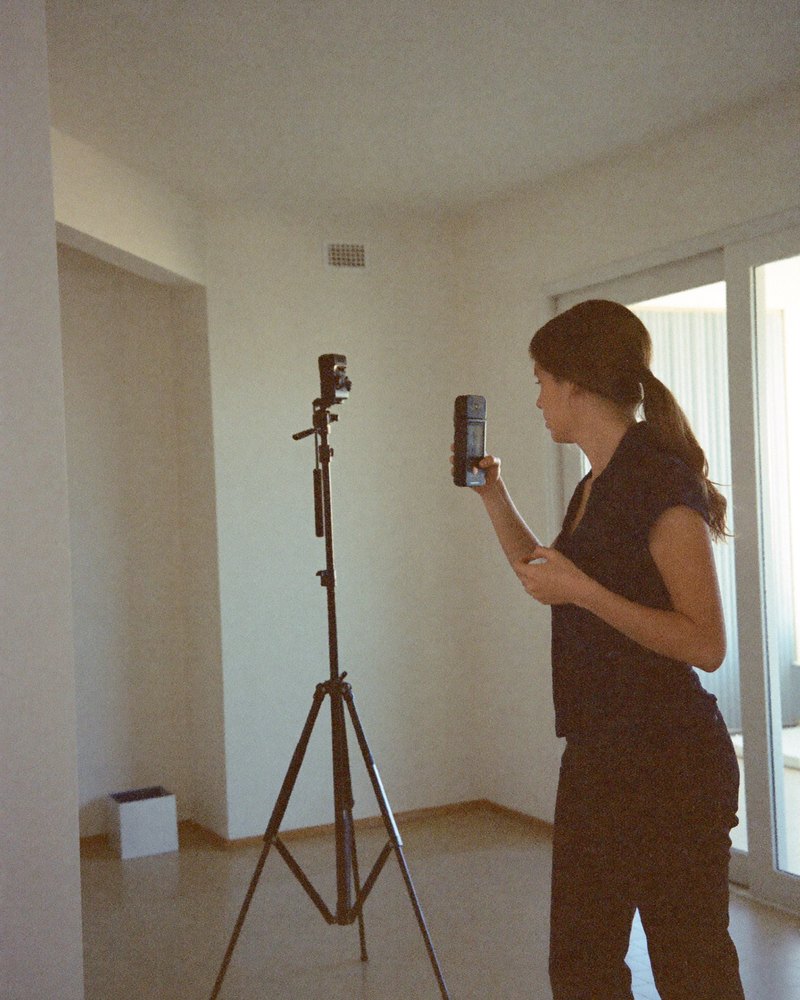
Set the tripod at roughly chest height, and shoot from a corner of the room rather than the doorway. That corner angle catches two walls instead of one, which is what actually reads as spacious, because it shows depth on two sides at once.
Shooting from the center of the room facing straight at one wall does the opposite. It flattens the space into a single plane, and buyers scroll past it without registering why the room felt small.
The tripod is about repeating the same height and angle in every room, so the whole set of photos feels like one consistent walk-through instead of a stack of random snapshots. Turn on your phone's grid lines and keep the vertical edges of doorways and walls straight in the frame; a tilted phone makes floors and walls lean, and buyers notice even if they can't say why.
That's the whole trick, and it costs a tripod and an extra ninety seconds per room. Download the photography brief for the exact shot list I give clients before a shoot, so nothing gets missed.
The order you shoot in matters almost as much as the angle
Shoot the widest, most impressive room first while the light is still at its best, since golden-hour light doesn't wait for you to finish the hallway bathroom. Save small, low-priority spaces like closets and utility rooms for whatever light is left.
Photograph the exterior and curb appeal separately, ideally at true golden hour, since a bright blue sky and warm siding sell the first impression before anyone clicks into the interior shots at all.
Move cars off the driveway, coil up any garden hoses, and pull trash cans out of frame before the exterior shots. These take thirty seconds and they're the difference between a listing photo and a snapshot of someone's Tuesday.
The five-minute edit that doesn't look edited
Correct exposure and white balance, straighten the verticals if the grid slipped, and stop there. Buyers can spot an over-saturated HDR photo instantly, and it reads as hiding something.
If a listing is above your market's price ceiling, going to auction, or needs a virtual tour or drone coverage, that's when hiring a professional stops being optional. The time you'd spend perfecting phone shots costs more than the shoot.
For everything else, these photos belong on your Google Business Profile too, since what shows up when people search you on Maps matters just as much as the listing itself.
A basic phone tripod is a one-time purchase you'll reuse on every listing after this one, which is worth remembering the first time it feels like an extra step on a busy showing day.
Frequently asked questions
Do I need a real camera, or is a phone enough?
A recent phone is enough for most listings if the light, clutter and angle are right. A dedicated camera earns its cost in low light and on higher-end listings where every detail gets scrutinized.
What's the best time of day to photograph a listing?
The hour or two after sunrise or before sunset, when outdoor light isn't overpowering the indoor lights. Overcast days work well too, since the light is even and soft.
Should I use my phone's HDR, panorama, or ultra-wide mode?
Use HDR sparingly, if at all, since it tends to flatten contrast and can look artificial. Skip panorama for interiors, since it distorts straight lines. Stick to the standard 1x lens rather than ultra-wide, which bends walls near the edge of the frame.
When should I hire a professional real estate photographer?
For listings near the top of your local market, anything needing a virtual tour or drone shots, or when you don't have time to shoot and edit properly. Below that, doing it right yourself is usually enough.
Do good photos actually help my Google Business Profile too?
Yes. The same interior shots you take for a listing work as profile photos, and a profile with real, current photos tends to get more attention than one with none.
I'll make sure these photos actually get seen somewhere that counts
Start with your Exploration and Analysis. Requesting it costs nothing, and I'll tell you what's right for you first.